
ERP-TMS Integration Stabilization: The 90-Day Recovery Framework That Prevents 80% of Implementation Failures While Meeting eFTI Compliance Deadlines

A German automotive parts manufacturer discovered their €800,000 TMS implementation mistake the hard way. Six months into deployment, they realized their new system couldn't handle their complex carrier network across 12 European countries. Sound familiar? You're watching budget overruns hit 75% of European TMS implementations, and 66% of technology projects end in partial or total failure.
Basic API integrations cost €5,000-€15,000, while complex ERP connections exceed €50,000. For shippers with freight spend exceeding €250M annually, implementation costs often run 2-3 times the subscription fee. Add regulatory deadlines that won't wait for your budget recovery, and you're facing the perfect storm that's already destroyed hundreds of ERP-TMS integration projects across Europe.
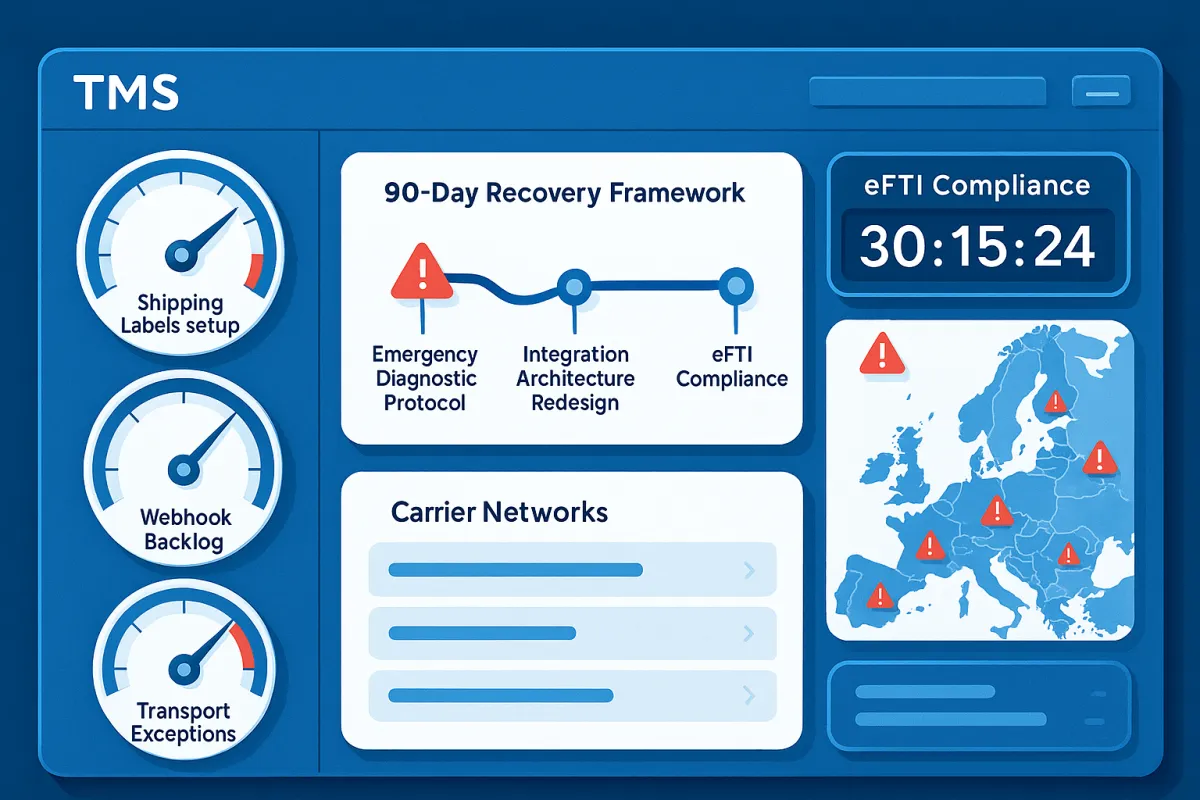
This 90-day recovery framework addresses the systematic failures plaguing European operations teams while ensuring compliance readiness for mandatory regulatory deadlines. eFTI Regulation applies in full from 9 July 2027, while Member State authorities must accept information shared electronically by operators via certified eFTI platforms. ICS2 version 3 messaging becomes mandatory from 3 February 2026, and decommissioning of older version (v2) means your integration must handle messaging format updates automatically.
The Perfect Storm: Why European Integrations Fail at Scale
Data mapping complexity between transportation management systems, ERP platforms, and legacy systems creates the first major failure point. European operations span 27 different regulatory frameworks, each requiring specific data formats, reporting schedules, and compliance documentation.
Legacy ERP systems compound the challenge. When your TMS can't handle carrier connectivity protocols that vary dramatically by country – French carriers might use different API standards than German logistics providers, while Scandinavian forwarders often require specialized integration approaches – you're looking at costly custom development work that wasn't in your original budget.
Vendor consolidation reduces your options precisely when you need them most. WiseTech's acquisition of E2open in 2025, Descartes' purchase of 3GTMS for $115 million in March 2025, and Körber's transformation of MercuryGate into Infios following their 2024 acquisition create uncertainty for integration planning. Companies undergoing integration often experience 12-18 months of reduced innovation while they harmonize platforms and teams.
Major players like Cargoson, MercuryGate, Descartes, SAP TM, and Oracle TM each take different integration approaches. Some prioritize API-first architectures, others focus on file-based exchanges, and several offer hybrid solutions. The fragmentation means your integration architecture decisions become vendor lock-in risks.
Phase 1: Emergency Diagnostic Protocol (Days 1-30)
Start with system compatibility audits that reveal hidden integration gaps. Document every system touching transport data: your ERP platform, warehouse management system, customer portals, carrier EDI connections, and reporting tools. Map data flows between these systems, identifying transformation points, storage locations, and access patterns.
Carrier connectivity protocol evaluation must account for European complexity. A basic domestic shipper requires 10-15 integrations minimum, potentially totaling 1,000-1,500 hours of labor. This complexity multiplies when you're managing pan-European operations with dozens of carrier relationships.
Regulatory compliance gap analysis requires immediate attention. An Economic Operator Registration and Identification (EORI) number is mandatory to connect to ICS2. Without an EORI, you cannot submit ENS data. Your ERP-TMS integration must validate EORI numbers in real-time and flag missing or incorrect registrations before shipment processing.
Data quality audits reveal hidden integration challenges. Most European operations discover their master data quality prevents effective automation. Address standardization of carrier codes, location IDs, service levels, and commodity classifications before proceeding to technical integration.
Phase 2: Integration Architecture Redesign (Days 31-60)
Hub-and-spoke versus point-to-point strategy selection determines your long-term maintenance burden. Point-to-point connections create exponential complexity as your carrier network grows, while hub-and-spoke architectures centralize data transformation but require more sophisticated middleware.
API-first transition planning addresses European regulatory requirements. The eFTI Regulation applies in full from 9 July 2027, ICS2 version 3 messaging becomes mandatory from 3 February 2026, and your current EDI-based TMS integrations cannot handle these requirements efficiently. Member State authorities must accept information shared electronically by operators via certified eFTI platforms starting July 2027.
API allows transportation management systems to transmit data in less than a second with cloud-based solutions, but integration quality matters more than speed. European operations require sophisticated error handling for cross-border documentation, customs validation, and multi-language communication protocols.
Data synchronization frameworks must handle regulatory format changes automatically. Start of application of the new version (v3) of ICS2 messages on 3 February 2026, and decommissioning of older version (v2) means your integration must handle messaging format updates automatically. Your API connections must adapt to regulatory changes without manual intervention.
Consider European-native solutions alongside global platforms. This consolidation creates three distinct vendor categories for European shippers: global mega-vendors (Oracle TM, SAP TM, E2open/WiseTech), European specialists (Alpega, nShift, Transporeon), and emerging European-native solutions like Cargoson that focus specifically on cross-border European operations.
Phase 3: Stabilization and Compliance Validation (Days 61-90)
Performance monitoring requires both technical and business metrics. Performance KPIs for integrated TMS-ERP environments should include data accuracy rates, real-time synchronization success, exception handling efficiency, and regulatory compliance metrics. Track API response times under peak loads, data synchronization success rates during system maintenance windows, and exception resolution timeframes.
Business outcome validation demonstrates integration value beyond technical metrics. Stabilization is about shifting from firefighting to continuous improvement. Transition support to BAU (business as usual) with clear ownership. Measure carrier onboarding time reduction, order processing accuracy improvements, and manual intervention requirements.
Regulatory testing validates compliance readiness before mandatory deadlines. Member States authorities may start accepting data stored on certified eFTI platforms for inspection from January 2026. Use this voluntary period for real-world testing and staff training.
Test integrations thoroughly with actual historical data before full deployment. Use your 2025 shipment data to validate integration accuracy before ICS2 enforcement intensifies. Run compliance scenarios that include EORI validation, customs documentation generation, and cross-border reporting requirements.
Budget Protection Strategies
Contract negotiation must address vendor stability during market consolidation. Companies undergoing integration often experience 12-18 months of reduced innovation while they harmonize platforms and teams. When your vendor becomes an acquisition target, you inherit integration risks and delays without managing the project directly.
Hidden cost identification prevents budget disasters. Hidden costs in TMS procurement consistently add 25-30% more than initial estimates, turning what looked like smart investments into budget disasters. The German manufacturer's mistake wasn't unique—it reflects a systematic problem where procurement teams focus on feature checklists while missing the integration complexity, carrier connectivity requirements, and ongoing maintenance expenses that define true TMS implementation costs.
Total cost of ownership modeling requires European-specific factors. Automation requires setup of connections with internal systems like ERP, plus external carriers for booking, tendering, status messages, and invoicing - and if you work with several carriers, this can be significant. Here's the reality check: many carriers aren't willing or able to create API connections, and even when they are, they'll charge integration costs to you.
Base licensing typically represents 20-30% of total costs, implementation expenses 25-40%, carrier integration fees 15-25%, ongoing support and maintenance 10-15%, and capacity shortage contingencies 5-10% additional buffer. These numbers reflect current market conditions before consolidation pressures increase pricing power.
Operational Success Metrics and ROI Measurement
Track leading indicators that predict integration health before customer impact. Performance KPIs for integrated TMS-ERP environments should include data accuracy rates, real-time synchronization success, exception handling efficiency, and regulatory compliance metrics. Monitor carrier API availability, webhook delivery success rates, and data validation error counts.
Cost optimization tracking validates financial assumptions. Plan for 15-20% budget increases in 2026-2027 if reactive, or 8-12% if proactive with proper contract protection. Budget planning around these timelines requires understanding both direct compliance costs and indirect operational impacts. Plan for 15-20% budget increases in 2026-2027 if reactive, or 8-12% if proactive with proper contract protection.
Implementation health monitoring prevents scope creep. The 90-day timeframe provides enough scope for meaningful change while maintaining urgency and focus. It allows organizations to achieve significant progress while limiting the risks associated with longer implementation periods.
Business value measurement captures both quantitative and qualitative improvements. KPIs vs. baseline at 30/60/90/180 days. Recommendation: Conduct Business Value Reviews at 3/6/12 months to quantify savings. Document reduced manual processing time, improved carrier relationship management, and enhanced regulatory compliance confidence.
The regulatory deadlines won't accommodate your implementation timeline. Organizations that act decisively in 2025-2026 can secure favorable contract terms and compliance-ready platforms before market consolidation limits options. Those that delay face reduced vendor choice, increased implementation timelines, and potential compliance gaps as 2027 deadlines approach. This 90-day framework provides the structured approach needed to recover from implementation failures while meeting mandatory compliance requirements.