TMS Agentic AI Governance Protocol: The 72-Hour Configuration Framework That Prevents 60% of Agent Permission Failures


Your TMS handles thousands of transactions daily. Each rate request, label generation, and carrier API call represents a decision point where AI agents can either operate smoothly within boundaries or exceed their intended scope. Recent data shows 88% of organizations experienced confirmed or suspected AI agent security incidents this year, with permission misconfigurations ranking as the leading cause of failures.
The shift from reactive TMS operations to autonomous agent-driven workflows creates new governance challenges. Unlike traditional systems that wait for human confirmation, agentic AI may initiate transactions, update records, or interact with other systems without human oversight. When your agent has access to carrier APIs, rate engines, and billing systems, a single misconfiguration can cascade into costly operational disruptions.
The Agentic AI Governance Gap Hitting TMS Operations
Transport management systems aren't immune to the broader agentic AI adoption crisis. Gartner predicts that over 40% of agentic AI projects will be scrapped by 2027, primarily due to a fundamental clash between autonomous AI's unpredictable nature and enterprise requirements for stability, compliance, and control.
Traditional TMS configuration approaches fall short because they assume human oversight at transaction points. You might carefully configure user roles for label generation, but what happens when an agent inherits those permissions and begins processing exceptions at 3 AM? Agentic governance must address action risk where agents may initiate transactions or update records without waiting for human confirmation.
The permission failure patterns are predictable. 82% of companies have AI agents accessing sensitive data daily, with 80% experiencing applications acting outside intended boundaries. Specific incidents include unauthorized access (39%), restricted information handling (33%), and even phishing-related movements (16%). In TMS environments, this translates to agents booking loads with unauthorized carriers, approving rates beyond thresholds, or accessing customer data without proper clearance.
Consider how platforms like Oracle TM, SAP TM, and MercuryGate are struggling with agent deployment governance. These established systems weren't designed for autonomous decision-making at the scale agentic AI demands. Newer platforms like Cargoson are building governance controls from the ground up, but the gap between deployment speed and safety measures remains wide across the industry.
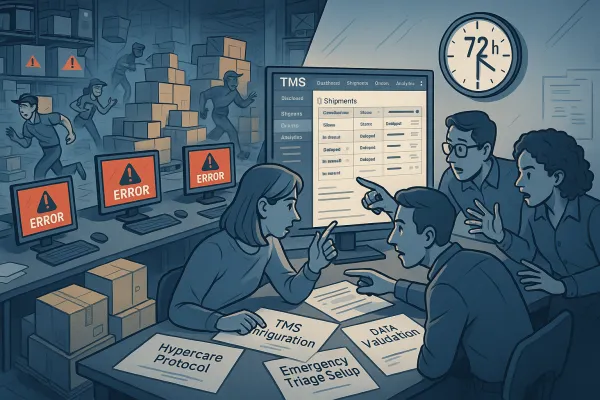
72-Hour Framework Overview: Risk Assessment → Boundaries → Testing
The Singapore Model AI Governance Framework provides a practical foundation for TMS agentic AI deployment. The framework emphasizes four dimensions: assessing and bounding risks upfront by selecting appropriate use cases and placing limits on agents' autonomy and access; making humans meaningfully accountable through defined checkpoints requiring human approval; implementing technical controls throughout the agent lifecycle; and enabling end-user responsibility through transparency and education.
This three-phase approach prevents the rushed deployments that create most permission failures. Only 14.4% of organizations report all AI agents going live with full security/IT approval, indicating that most teams are bypassing governance protocols in favor of speed.
Your 72-hour window forces disciplined thinking about autonomy levels. During rate negotiations, should your agent approve anything under $500? Under $50? What about routing changes that affect delivery windows? The framework requires you to define these boundaries before deployment, not after your first incident.
Phase 1 (Hours 0-24): Risk Assessment and Action-Space Definition
Start by mapping your agent's intended action space within your TMS ecosystem. Document every system, API, and database your agent will access. This isn't just an IT exercise—you're defining the blast radius of potential failures.
Create a permission matrix showing exactly which carrier APIs your agent can access. Can it book with all approved carriers or only a subset? Does it have read-only access to customer data or can it modify records? Document rate engine permissions: can the agent request quotes from all carriers simultaneously or only specific ones based on shipment characteristics?
For label generation boundaries, specify which shipping services the agent can select. Express delivery authorizations should require different approval thresholds than ground shipping. Define geographic limitations—perhaps your agent handles domestic shipments autonomously but escalates international ones.
The risk assessment must account for downstream impacts. When your agent updates a shipment status, which other systems receive that information? ERP updates, customer notifications, and carrier tracking all depend on accurate status changes. A permission failure here affects multiple stakeholders.
Phase 2 (Hours 24-48): Autonomy Boundaries and Human Checkpoints
Configure when agents act independently versus requiring approval. Dollar thresholds are obvious starting points—many TMS teams set $1,000 as the autonomous approval limit for rate exceptions. But consider other triggers: shipment delays affecting promised delivery dates, carrier substitutions for committed lanes, or routing changes that impact fuel costs.
Design escalation rules for exception handling. When a preferred carrier shows "capacity full," should your agent automatically select the backup carrier or wait for human review? The answer depends on your service level commitments and cost structure. High-value customers might warrant human intervention for any carrier changes.
Workflow diagrams become crucial documentation. Map decision trees showing when agents proceed independently and when they pause for approval. These diagrams help during incident reviews—you can trace exactly where human oversight was bypassed.
Human-in-the-loop triggers should address approval bias. Increased agent capability creates challenges for effective human accountability, including automation bias—the tendency to over-trust automated systems that have performed reliably in the past. Design checkpoints that require active decision-making, not just rubber-stamping agent recommendations.
Phase 3 (Hours 48-72): Testing and Monitoring Setup
Validation protocols prevent agents from learning incorrect behaviors during testing. Create sandbox environments that mirror your production TMS but with limited financial impact. Test with small shipment volumes and non-critical lanes before expanding scope.
Audit trail configuration becomes your safety net. Real-time dashboards that track agents' actions and flag anomalies are essential for immediate incident management. Your monitoring should capture every API call, rate approval, and status update with timestamps and decision rationale.
Anomaly detection setup requires baseline establishment. During your first weeks of agent operation, document normal behavior patterns: average processing times, typical rate ranges, and standard carrier selections. Deviations from these baselines trigger alerts.
Rollback procedures must be tested before you need them. If your agent starts approving unexpectedly high rates, can you quickly revert to manual processing? Document the specific steps to disable agent functions and resume human oversight without losing shipment data.
Common Permission Failure Patterns and Prevention
The six most frequent TMS agent misconfigurations follow predictable patterns. First, overbroad carrier access where agents can book with any carrier in your system, including those reserved for specific customers or high-value shipments. Prevention requires role-based API access that matches your business rules.
Second, missing rate limits allow agents to approve costs far exceeding normal ranges. A misconfigured agent might approve a $2,000 expedited shipment because it lacks context about your typical $200 shipping costs. Implement both absolute dollar limits and percentage-based thresholds relative to standard rates.
Third, escalation gaps occur when agents can't reach human reviewers. Your agent might pause a critical shipment at 2 AM waiting for approval that won't come until morning. Design escalation paths with backup reviewers and emergency overrides.
Fourth, credential inheritance problems arise when agents use shared service account credentials. 45.6% of teams still rely on shared API keys for agent-to-agent authentication, while 27.2% use custom, hardcoded logic for authorization. This makes accountability impossible during incident investigations.
Fifth, cross-system boundary violations happen when agents access systems beyond their intended scope. Your shipping agent might query customer payment data to "optimize" service levels, creating compliance violations.
Sixth, temporal permission drift occurs as your business rules change but agent configurations remain static. Carrier rate agreements expire, service levels change, and customer requirements evolve, but agents continue operating under outdated parameters.
Platform comparison reveals different approaches to these challenges. BluJay's governance relies heavily on role inheritance from user permissions. Transporeon implements hard stops at defined thresholds. nShift focuses on audit trail completeness. Cargoson's approach emphasizes explicit agent identity management, avoiding the shared credential problems that plague other platforms.
Post-Deployment: Continuous Governance and Incident Response
Weekly governance reviews become essential operational discipline. Schedule standing meetings to review agent decisions, analyze approval patterns, and identify drift from expected behavior. More sophisticated approaches include deploying governance agents that monitor other AI systems for policy violations and security agents that detect anomalous agent behavior.
Incident classification helps prioritize response efforts. Category 1 incidents involve financial impact: agents approving incorrect rates or booking with non-contracted carriers. Category 2 covers service disruptions: missed pickups or delivery delays caused by agent errors. Category 3 addresses compliance violations: accessing restricted data or bypassing required approvals.
Learning loops ensure incidents drive improvement. Document not just what went wrong, but why your governance controls failed to prevent it. Did the agent operate within its defined permissions but still cause problems? This suggests scope refinement is needed. Did it exceed boundaries but wasn't detected quickly enough? Your monitoring needs improvement.
Response time expectations must account for agent speed. A compromised agent acting as a confused deputy can cause more damage than a traditional attacker because it operates at machine speed and scale. Your incident response procedures need to match this velocity with rapid containment protocols.
Compliance Considerations: EU AI Act and Industry Standards
The EU AI Act creates specific requirements for agentic AI systems in transportation. Organizations must adopt standards like ISO/IEC 42001, which provides the management system framework necessary to document oversight and demonstrate control to regulators. Your TMS agent's decision-making process must be auditable and explainable.
Documentation requirements extend beyond technical logs. You need clear policies explaining how agents make decisions, what data they access, and when humans intervene. Enhanced governance processes include developing clear frameworks for deployment and oversight, documenting decision-making processes, and implementing least-privilege permissions with sandboxed execution environments.
Audit trail mandates require persistent logging of all agent actions. Your logs must show not just what the agent did, but why it made those decisions. This includes the data inputs considered, business rules applied, and alternative options evaluated.
Liability considerations become complex when agents make autonomous decisions. If your agent books a shipment with an unreliable carrier and delivery fails, who bears responsibility? Your contracts with customers, carriers, and technology providers need clear language about agent-driven decisions and accountability frameworks.
The 72-hour governance framework provides a practical path forward, but success requires ongoing commitment to monitoring, refinement, and learning. For agentic AI to scale safely across the enterprise, guardrails must be built in from the start, not bolted on later. Start small, measure carefully, and expand scope only after proving your governance controls work under real operational pressure.