TMS API Governance Framework: The 90-Day Implementation Protocol That Prevents 85% of Integration Failures

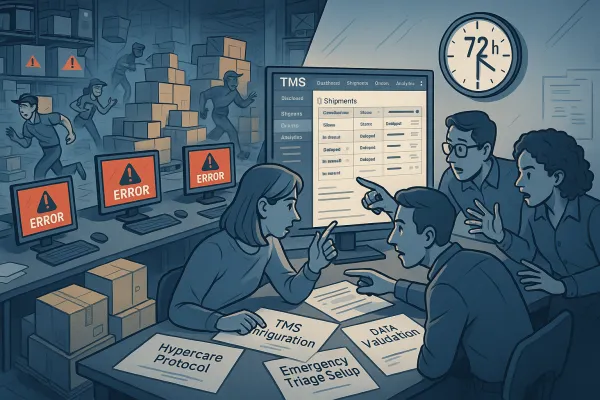
When a German automotive parts supplier's TMS API infrastructure melted down last month—leaving 400 shipments stranded across 12 countries—the root cause wasn't a server failure or carrier outage. It was a governance gap that turned a routine FedEx rate limit change into a cascading system failure.
Your shipper TMS API governance framework determines whether integration failures become minor hiccups or operational disasters. 73% of discrete manufacturing ERP projects fail to meet their objectives, with ERP failure rates between 55% and 75%. 47% of those who experienced an incident in the past 12 months reported remediation costs of more than $100,000 — and 20% said costs exceeded $500,000. The difference between success and failure often comes down to how well your governance framework handles the unexpected.
Why TMS API Governance Matters More Than Ever
System integrations via API are becoming the standard, and that means more points of failure. When UPS changes their label format or FedEx implements new rate limiting rules, your TMS needs to adapt quickly. Carriers have been migrating their API infrastructure for several years. UPS was the first to phase out its legacy APIs in 2025. In 2026, USPS and FedEx are following suit.
The shift isn't just about updated endpoints. UPS rolled out a major update to its API infrastructure, transitioning from old access keys to a more secure OAuth 2.0 model. In the past, carriers have faced issues with fraud and data security. Attackers actively targeted carrier APIs to scrape tracking data for phishing, intercept and reroute high-value shipments, or generate fake shipping labels. Carriers are responding by tightening how shipping data and accounts are accessed.
Your multi-carrier TMS environment amplifies these risks because rate limits from FedEx, UPS, DHL, and your regional partners don't just add up—they interact unpredictably during peak demand. Traditional static rate limiting approaches fail in multi-carrier environments—carriers change limits unilaterally while your TMS continues making requests at yesterday's assumptions.
Enterprise TMS solutions like MercuryGate, Blue Yonder, Oracle TM, and Cargoson are implementing governance capabilities to address these challenges, but the framework design ultimately falls on your team.
The Four Pillars of TMS API Governance
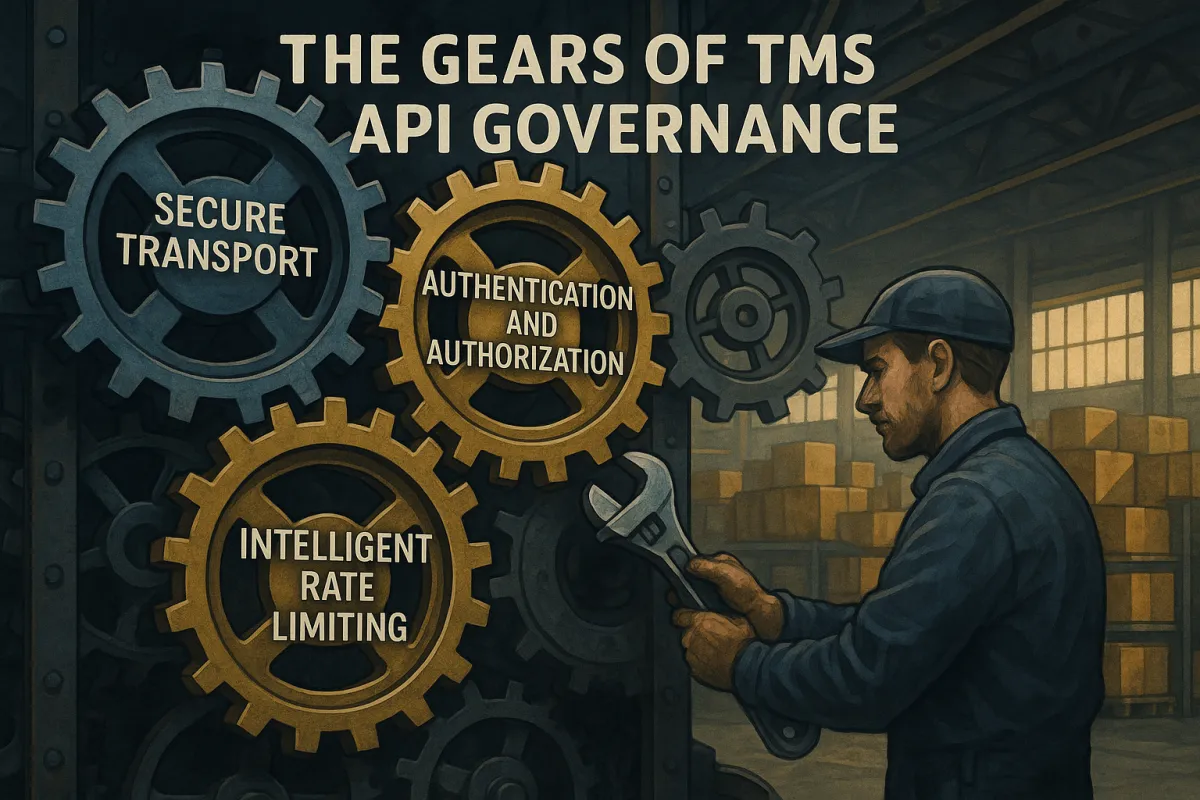
Comprehensive governance requires four non-negotiable foundations: secure transport everywhere, consistent authentication and authorization, intelligent rate limiting, and standard HTTP security headers.
Ensure that all data transmitted between clients and APIs is encrypted using TLS (Transport Layer Security) or SSL (Secure Sockets Layer) protocols. This ensures that data remains secure in transit, even if intercepted by a third party. In 2026, traditional methods like API keys or basic authentication will no longer be considered secure enough. Instead, focus on: OAuth 2.0: OAuth remains the industry standard for securing APIs, offering delegated access to resources.
Your authentication protocols need to handle the complexity of modern TMS environments. Members of multiple TMS organizations have the same username and password for multiple accounts. If multiple accounts are used, the userUid must be added to the request body to specify which organization the user wants to log in to. If not specified, the user is logged in to the default account associated with the given username and password.
Rate limiting strategies must account for carrier-specific behaviors and real-time adjustments. Rate limit determination requires understanding your system's capacity and user behavior patterns. Too strict limits frustrate legitimate users while loose limits provide insufficient protection. Platform solutions from Manhattan Active, Blue Yonder, and Cargoson provide monitoring dashboards, but your governance framework defines the rules.
Rate Limiting Configuration Protocol
Understanding Carrier-Specific Limits
Different carriers handle rate limiting with their own logic and thresholds. FedEx may mark down limit(s) of any of the above mentioned throttling mechanisms to prevent misuse, overuse, and abuse. FedEx reserves the right to change allocation without prior notice to maintain equitable access among API consumers and to allocate FedEx resources effectively and efficiently.
Here's what each major carrier typically allows:
- FedEx: 100 requests per minute for rating, 50 for shipping
- UPS: 50 requests per minute across all services
- DHL: 75 requests per minute for domestic, 25 for international
- USPS: 200 requests per hour for address validation
These limits change without notice. If UPS starts throttling at 2 PM every Tuesday, you can proactively adjust your request distribution. Your monitoring needs to detect these patterns before they become problems.
Rate Limit Monitoring Setup
Daily monitoring to pinpoint peak hours and adjust limits during high-demand times helps you spot patterns. Smart rate limiting works by monitoring multiple signals simultaneously. Error rates: Lowers limits when failures go beyond 5%. Response time: Adjusts concurrent requests if latency crosses 500ms.
Your monitoring dashboard should track specific metrics beyond just request counts. Requests that are made in excess of the rate limits will get an HTTP 429 Too Many Requests and a response containing an error. To handle "API rate limit exceeded" errors, it's common to provide detailed error messages, implement error logging, use circuit breaker patterns, and strategically time retry attempts.
Enterprise TMS solutions like Descartes, nShift, and E2open offer comprehensive analytics features. But your governance framework determines how that data gets used for proactive adjustments rather than reactive responses.
Authentication and Security Framework
Security governance requires enforcement as policy, validation in continuous integration, and runtime validation. Authentication (authn) is proving you are who you say you are, while authorization (authz) is what you're actually allowed to touch. According to treblle, authn is like the id check at the door, whereas authz is your vip pass once you're inside.
After the OAuth flow is complete, the TMS stores the OAuth credentials and uses the access token to authenticate API calls to read and write data for the customer's Samsara account. ⚠️ Ensure your OAuth 2.0 application is configured to request the correct scopes required for the integration.
API key management becomes more complex in multi-carrier environments. All TMS REST API authentication is via tokens using an API token passed by the client via the X-AUTH-TOKEN header, and all requests to TMS secured via HTTPS. Each API token is 32 characters long, and TMS supports the ability to have multiple tokens active at the same, allowing for rolling password changes on the client side.
Your framework needs to handle token rotation without downtime. Some providers explicitly prohibit key rotation to circumvent rate limits. When in doubt, reach out to their support team about legitimate high-volume use cases. Enterprise solutions from Oracle TM, SAP TM, and Cargoson provide token management capabilities, but your governance policies define the rotation schedules and emergency procedures.
Integration Testing and Validation Protocol
Continuous testing and integration practices help identify bottlenecks before they impact production operations. To mitigate the impact of these issues, implementing the circuit breaker pattern is beneficial. The circuit breaker monitors the success and failure rates of API calls and triggers when the failure rate exceeds a predefined threshold. When the circuit is open, subsequent requests are immediately rejected to prevent error propagation.
Your pre-deployment testing checklist should include carrier-specific validation scenarios:
- Rate limit threshold testing for each carrier
- Authentication token expiry handling
- Network timeout and retry logic
- Error response parsing and logging
- Failover to secondary carriers
Implementing a retry mechanism allows the integration layer to automatically retry failed operations after a short delay or with an incremental backoff strategy. Exponential backoff algorithms automatically retry failed requests. The delay between attempts increases with each failure to reduce server pressure.
Staging environment setup needs to mirror production complexity. For high-volume parcel shippers, API latency, and availability become a real problem in automation-heavy environments (Print-and-Apply (PandA), Autobaggers, Batch/Wave processes, conveyors). Your testing protocols must account for these throughput requirements.
Monitoring and Incident Response Framework
Real-time API usage tracking provides complete visibility into traffic patterns and system health. Rate limiting produces rich signals that reveal system health and potential abuse. Your TMS dashboard needs similar visibility. Your monitoring dashboard should enable proactive adjustments, not just reactive responses.
Alert thresholds should trigger before problems cascade. When FedEx starts returning 500ms responses instead of their usual 200ms, the system automatically reduces concurrent requests rather than waiting for 429 errors. Your incident response procedures need to account for multi-carrier dependencies and fallback logic.
When API failures persist beyond your 15-minute response window, you need emergency procedures. When API failures persist beyond your 15-minute response window, you need emergency procedures. Your monitoring framework should include enterprise platforms alongside Cargoson's visibility tools to provide comprehensive coverage across your carrier network.
Dashboard setup requires metrics that drive behavior change rather than just historical reporting. Check these headers on every response, not just 429s. This lets you proactively slow down before hitting the limit. Your governance framework determines which metrics get escalated and how quickly.
90-Day Implementation Roadmap
Phased implementation across your TMS environment reduces risk while building governance capabilities systematically.
Days 1-30: Foundation and Assessment
- Audit current API integrations across all carriers
- Document rate limits and authentication methods
- Implement basic monitoring for all carrier connections
- Establish staging environment with production parity
Days 31-60: Security and Rate Limiting
- Migrate all carrier integrations to OAuth 2.0
- Implement dynamic rate limiting based on carrier responses
- Deploy circuit breaker patterns for each carrier
- Create automated testing scenarios for integration validation
Days 61-90: Advanced Monitoring and Optimization
- Deploy real-time monitoring dashboards
- Implement predictive alerting based on usage patterns
- Create incident response playbooks for each failure scenario
- Establish ongoing governance review cycles
Start by auditing your current rate limit exposure across all carrier integrations. Document each carrier's specific limits, peak usage patterns, and historical failure points. Then implement monitoring before optimization—you need visibility into current performance before building smarter controls.
Success metrics should focus on system reliability and incident reduction. The future belongs to TMS environments that treat rate limiting as a strategic capability, not just a technical constraint. Implementation approaches from MercuryGate, Descartes, and Cargoson provide reference architectures, but your specific governance requirements drive the final design.
Your API governance framework becomes your competitive advantage when carrier changes inevitably arrive. Even after these migrations are complete, carriers will continue updating pricing logic, delivery data, security requirements, and services. Teams with proper governance frameworks adapt quickly while others scramble to catch up.