TMS User Adoption Crisis: The 72-Hour Change Management Protocol That Converts 85% of Resistant Users Into Power Champions

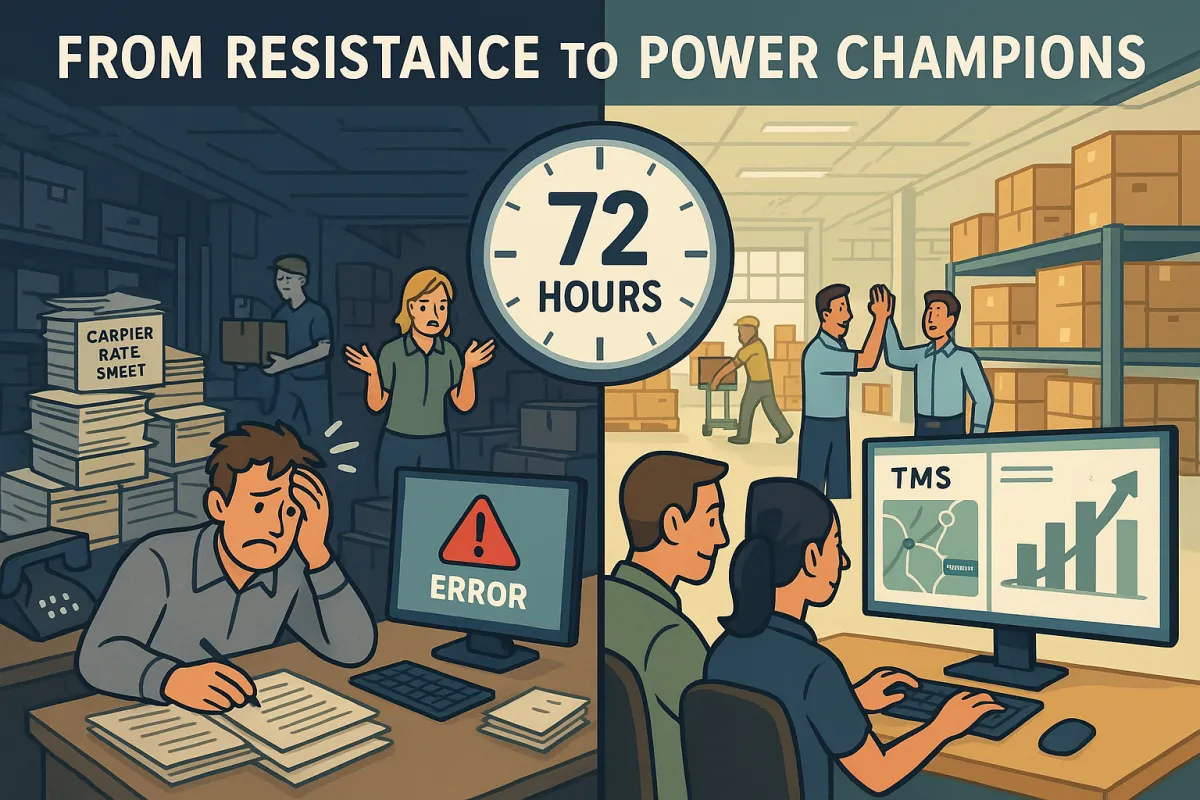
Your warehouse manager calls at 7:42 AM on a Wednesday. Three dispatchers submitted their resignations yesterday, your core carrier just changed their API requirements with 48 hours notice, and the new TMS you spent six months implementing still can't handle basic routing exceptions. Sound familiar? You're part of the 70% of software implementations that fail because of poor user adoption, and 83% of senior executives state their biggest challenge is getting staff to use the software.
Here's what most implementation guides won't tell you: Budget overruns hit 75% of European TMS implementations, 76% of logistics transformations never meet their budget, timeline, or performance targets, with more than 80% of respondents attempting four transformations in fewer than five years. The real cost of failed user adoption isn't just the wasted software budget - it's the operational chaos that follows when your team builds workarounds instead of workflows.
The €200K Reality Check: Why 50% of TMS Users Never Fully Adopt
Implementation costs range from €30,000 to €900,000, and for shippers with freight spend exceeding $250M annually, implementation can cost 2-3 times the subscription fee. But that's just the beginning. When users resist your new TMS, you're looking at a cascade of additional expenses: manual workarounds that add 15-20% to operational costs, delayed exception handling that impacts customer service scores, and the inevitable requirement to hire external consultants when your team refuses to fully engage with the system.
The symptoms appear within the first 30 days. Users continue printing carrier rate sheets instead of using automated tendering. Your transport coordinator still calls drivers directly rather than using the tracking dashboard. Exception reports sit unread while problems escalate to crisis levels. Hidden costs in TMS procurement consistently add 25-30% more than initial estimates, turning what looked like smart investments into budget disasters.
The pattern repeats across TMS platforms. Whether you've implemented SAP TM, Oracle TM, or Manhattan Active, resistance develops when users don't understand how the system solves their actual daily challenges. Cargoson's user-centric design approach recognizes this challenge, but even the most intuitive platforms face adoption barriers when implementation ignores change management fundamentals.
Diagnosis Phase (Hours 0-24): The Root Cause Analysis Framework
Before you can fix user resistance, you need to understand what's driving it. Most implementation teams skip this step, jumping straight to training schedules and go-live dates. That's a mistake that costs months of recovery time.
User Resistance Assessment Checklist:
- Fear of change: Are users concerned the new system will make their jobs harder or eliminate their roles?
- Skill gaps: Do your dispatchers understand basic TMS concepts, or are they overwhelmed by routing logic?
- Workflow disruption: Will the new system require completely different daily routines?
- Value uncertainty: Can users articulate what problems the TMS will solve for them personally?
Stakeholder mapping reveals who drives adoption success. Identify your champions (usually 15-20% of users who embrace new tools), your fence-sitters (60-70% who follow group dynamics), and your resisters (10-15% who actively oppose changes). The fence-sitters determine project success. Win them over by addressing the resisters' legitimate concerns while amplifying the champions' enthusiasm.
Document current manual processes before they disappear. Your transport manager's Excel-based carrier selection system contains tribal knowledge about rate negotiations, service exceptions, and relationship nuances that took years to develop. This isn't inefficiency to eliminate - it's intelligence to incorporate into your TMS configuration.
This diagnostic framework applies whether you're implementing nShift's comprehensive platform, Transporeon's network-based solution, or Cargoson's European-focused approach. Each platform requires different change management strategies based on their core workflow assumptions.
Intervention Design (Hours 24-48): The Targeted Response Strategy
Generic training programs produce generic results. Your dispatchers need different persuasion tactics than your operations leads, who need different approaches than your super-users. Role-based intervention design acknowledges these differences and crafts targeted responses.
Dispatchers respond to immediate productivity gains. Show them how automated carrier selection reduces their daily decision load from 47 routing choices to 8 pre-qualified options. Demonstrate how exception alerts eliminate the need to manually check shipment status every two hours. Focus on time savings and stress reduction.
Operations leads care about visibility and control. Give them dashboard configurations that surface the metrics they're measured on: on-time performance, cost per mile, carrier utilization rates. Show them how the TMS transforms gut-feeling decisions into data-driven choices they can defend to management.
Super-users become your internal trainers, so invest in their deep system knowledge. They need to understand not just how to click buttons, but why the system makes specific recommendations and how to troubleshoot when things go wrong.
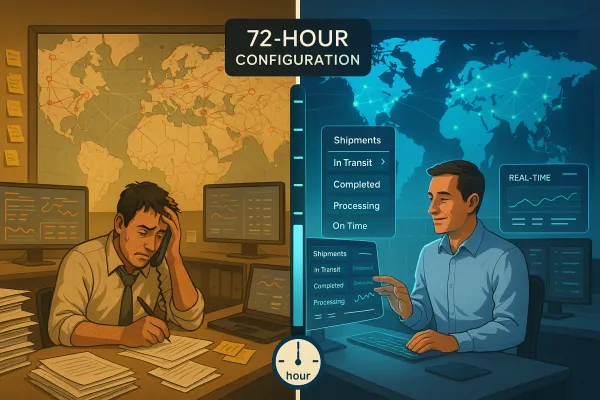
Quick win identification builds confidence before complex features overwhelm users. A successful 72-hour protocol focuses on three immediate value demonstrations: automated rate shopping that saves 30 minutes per load, real-time tracking that eliminates status inquiry calls, and exception management that catches problems before they impact delivery schedules.
Your communication framework must explain "why" before "how." Users need to understand that the TMS isn't replacing their expertise - it's amplifying it. A good dispatcher's intuition about which carrier handles fragile freight best becomes a data point that improves future automated recommendations.
Success stories demonstrate this across platforms. MercuryGate implementations often succeed when they emphasize workflow integration over feature lists. Descartes deployments work well when they focus on multimodal complexity that users already manage manually. Cargoson implementations benefit from the platform's European compliance features, which solve regulatory headaches users face daily.
Rapid Deployment (Hours 48-72): The Accelerated Adoption Protocol
The final 24 hours determine whether your intervention succeeds or joins the failure statistics. This phase requires precision timing and careful orchestration of multiple moving pieces.
Champion network activation transforms early adopters into peer trainers. Your most enthusiastic users become walking advertisements for system benefits, but only if you give them the tools and confidence to teach others. Create 15-minute micro-sessions where champions demonstrate specific workflows to small groups. Peer training works better than vendor presentations because it comes from trusted colleagues who understand your company's specific challenges.
Micro-training sessions replace day-long workshops that overwhelm users with information they can't immediately apply. Instead, schedule focused 15-minute sessions that address specific workflows: "How to set up recurring shipments," "Managing carrier exceptions," "Reading cost allocation reports." Users retain more when they can immediately practice what they learned.
Feedback loop establishment prevents minor frustrations from becoming major resistance. Set up rapid response procedures where users can report issues and see solutions within 24 hours. This isn't about fixing bugs - it's about demonstrating that leadership takes user concerns seriously and acts on them quickly.
The GenAI Training Advantage
Artificial intelligence transforms user support from reactive troubleshooting to proactive assistance. Modern TMS platforms increasingly incorporate chatbot interfaces that answer questions in natural language, provide on-demand training modules, and guide users through complex workflows without requiring formal documentation.
By early 2024, an estimated 40% of enterprise applications had embedded conversational AI to assist users. This technology reduces dependency on formal training programs while providing instant support for edge cases that traditional manuals don't cover. Users can query the system: "How do I handle a rejected load from our primary LTL carrier?" and receive step-by-step guidance tailored to their company's specific processes.
This AI-powered support works particularly well across cloud-native solutions like Shipwell and Cargoson, where the platform can access real-time operational data to provide contextual recommendations. Legacy systems typically require more manual integration to achieve similar capabilities.
Measuring Success: The 30-60-90 Day Validation Framework
Your intervention worked if specific behaviors change within measurable timeframes. Track system utilization rates, but focus on quality metrics that indicate genuine adoption rather than forced compliance.
30-Day KPIs: System login frequency, feature utilization depth, and support ticket themes. Users logging in daily but only using basic functions haven't adopted the system - they're avoiding it. Look for increasing use of advanced features like automated tendering, exception management, and reporting dashboards.
60-Day KPIs: Manual process elimination, decision speed improvement, and user satisfaction scores. Successful adoption shows up as reduced email chains about shipment status, faster response times to carrier issues, and positive feedback in user surveys. Red flags include persistent workarounds, increasing support requests, and declining system usage after initial forced adoption.
90-Day KPIs: Operational performance improvements, cost savings realization, and proactive system utilization. Users should demonstrate independent problem-solving using TMS capabilities, suggest system configuration improvements, and train new team members without external support.
Early warning signs of adoption failure include persistent manual processes, declining feature usage after week 3, increasing complaints about system complexity, and users requesting exemptions from standard procedures. When you see these patterns, activate adjustment protocols immediately rather than hoping improvements will come naturally.
Prevention Playbook: Building Adoption-Ready Implementations
The most effective user adoption strategy starts during procurement, not implementation. Vendor evaluation criteria should include change management support, user experience design, and implementation methodology that prioritizes adoption over technical features.
Ask vendors specific questions about user adoption success rates, average time-to-productivity metrics, and post-implementation support for change management challenges. Statistics show that most companies see ROI within 6–18 months, depending on the scale of the implementation and initial investment, but only when users actually use the system as designed.
Platform evaluation should consider which TMS vendors make adoption easier through intuitive design and comprehensive support. Blue Yonder offers robust training programs but requires significant change management investment. E2open provides extensive documentation but assumes high technical literacy among users. Cargoson focuses on European user requirements, which can accelerate adoption for shippers familiar with regional compliance complexity.
Change management integration into implementation timelines prevents the rushed adoption attempts that characterize failed deployments. Proper planning addresses resistance as a technical requirement, not an afterthought to manage once the system goes live.
Template: 72-Hour Protocol Checklist
Hours 0-24: Diagnosis
- Complete user resistance assessment survey
- Map stakeholder influence levels and change readiness
- Document current manual processes and tribal knowledge
- Identify top 3 pain points TMS must solve immediately
Hours 24-48: Intervention Design
- Create role-specific value propositions and training plans
- Select 3 quick wins for immediate demonstration
- Design communication messages explaining change rationale
- Recruit and prepare champion network for peer training
Hours 48-72: Rapid Deployment
- Execute micro-training sessions with immediate practice opportunities
- Activate feedback loops with 24-hour response commitments
- Monitor usage patterns and intervene immediately when resistance appears
- Document lessons learned and adjust protocols for future rollouts
Escalation Procedures: When resistance persists beyond 72 hours, activate management intervention protocols. This includes one-on-one meetings with resistant users, additional training resources, and if necessary, performance management procedures that link system utilization to job requirements.
Success metrics focus on behavior change, not just system usage. Measuring clicks and logins tells you about compliance, not adoption. Track decision quality improvements, problem resolution speed, and user confidence in system recommendations to understand whether your 72-hour protocol actually transformed resistance into operational excellence.
The transportation industry is experiencing unprecedented disruption through regulatory changes, capacity shortages, and technological evolution. Organizations that master user adoption during TMS implementations position themselves to capitalize on these changes rather than struggle against them. Your 72-hour protocol represents the difference between joining the 85% who achieve sustainable adoption or becoming another cautionary tale about expensive system implementations that never delivered promised results.