
TMS API Integration Monitoring: The 15-Minute Recovery Framework That Prevents 90% of Carrier Authentication Failures Before They Break Your Shipping Workflows

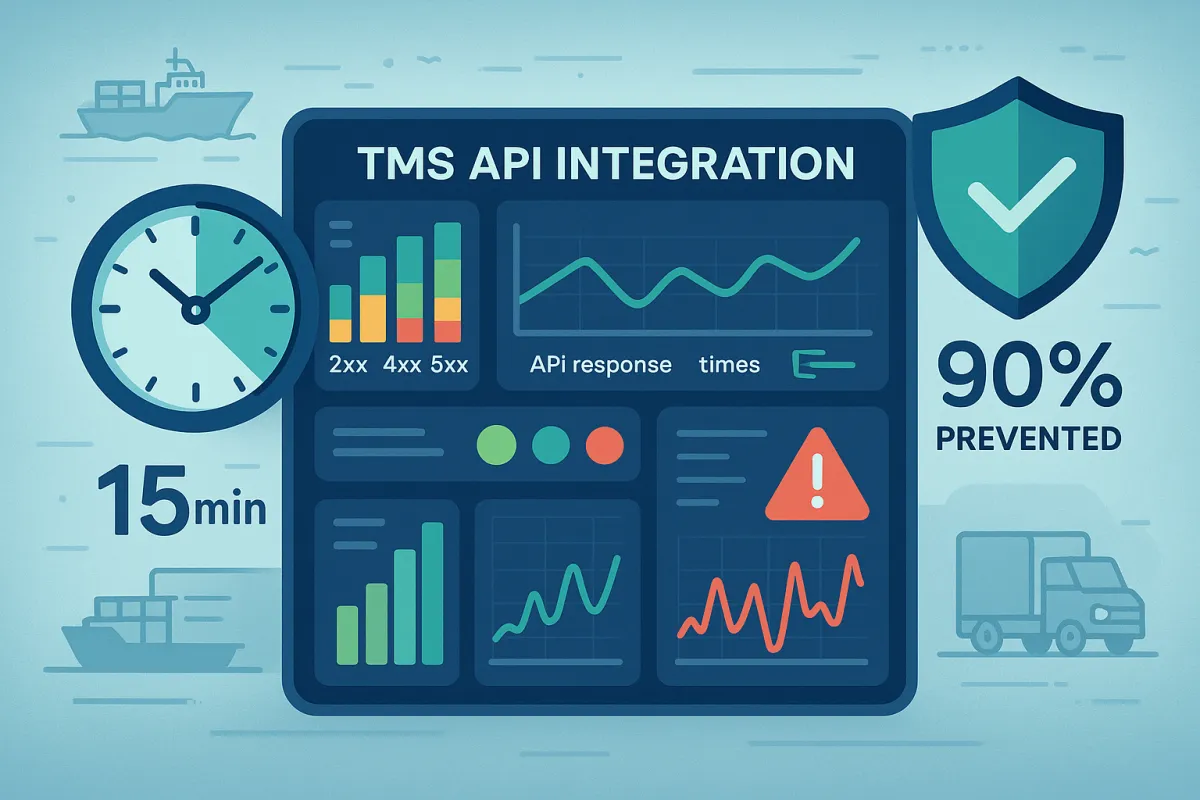
Your TMS integration monitoring setup isn't catching what matters most. While your dashboard shows green lights across all carrier APIs, authentication failures are building up behind the scenes. 73% of integration teams reported production authentication failures within weeks of carrier API deployments that sailed through sandbox testing. Yet these same teams spent months perfecting their integration against stable test environments, only to discover that production environments operate under completely different rules.
The problem runs deeper than generic uptime checks. A degraded carrier API during peak season can cost over $100,000 per hour in fulfillment disruption. When FedEx's API starts throttling your rate requests or UPS OAuth tokens expire during Black Friday processing, standard monitoring tools like Datadog or New Relic report everything as normal. They see HTTP 200 responses while your shipping workflows quietly break.
The Silent API Integration Crisis Breaking TMS Operations in 2026
The Web Tools API platform shut down on Sunday, January 25, 2026, marking just the beginning of a massive wave of carrier API retirements hitting enterprise integration teams. June 2026: Remaining SOAP-based endpoints will be fully retired. This isn't just another upgrade cycle. Carriers, including UPS, FedEx, and USPS, have accelerated their API release cycles heading into 2025 and 2026, with migration windows shrinking as the number of affected integrations per enterprise grows.
This update fundamentally changes how OAuth 2.0 implementations must handle security, with RFC 9700 now mandating PKCE for all client types, including server side apps. For carrier API integrations already struggling with authentication failures—73% of integration teams reported production authentication failures after similar UPS OAuth migrations—RFC 9700 exposes critical vulnerabilities that require immediate action.
The authentication crisis compounds when multiple carriers update simultaneously. We documented specific cascade patterns: FedEx rate limits trigger failover to UPS, which then hits its limits and fails over to DHL, creating a "carrier domino effect" that exhausts all available options within 90 seconds. When FedEx, DHL, and UPS APIs all throttle simultaneously during Black Friday volume, those theoretical improvements disappear fast.
Why Standard Monitoring Tools Miss Critical TMS Integration Failures
While Datadog might catch your server metrics and New Relic monitors your application performance, neither understands why UPS suddenly started returning 500 errors for rate requests during peak shipping season, or why FedEx's API latency spiked precisely when your Black Friday labels needed processing. Real carrier API monitoring requires understanding what specific failure patterns look like in production.
Standard monitoring tools treat all APIs the same, but that assumption breaks quickly with carriers. Carrier APIs don't follow consistent header standards. FedEx uses proprietary headers, UPS implements rate limiting through error codes, and DHL varies by service endpoint. OAuth failures often surface as generic authorization errors rather than obvious outages. A 401 Unauthorized or 403 Forbidden response could indicate an authorization server problem, an expired token, incorrect scopes, or an application bug.
When your system hits FedEx's rate limits, you get proprietary throttling signals. When DHL's authentication expires, their error responses look nothing like UPS's OAuth failures. OAuth failures often surface as generic authorization errors rather than obvious outages. A 401 Unauthorized or 403 Forbidden response could indicate an authorization server problem, an expired token, incorrect scopes, or an application bug. Your monitoring needs to decode these carrier-specific patterns instead of grouping them as generic HTTP errors.
Platforms like Cargoson, EasyPost, ShipEngine, and nShift handle this complexity by building carrier-specific monitoring into their abstraction layers. They understand that UPS rate limiting behaves differently than FedEx throttling, and their alerting systems account for these differences.
The 15-Minute Carrier-Aware Monitoring Setup Protocol
You don't need months to implement monitoring that actually catches carrier authentication failures. Here's the tactical setup that works:
Step 1: Establish carrier-specific baselines
Configure connection timeouts to 30 seconds for rate quotes and 60 seconds for label generation. Shorter timeouts create unnecessary failures during peak periods. UPS APIs typically respond within 200-400ms for authentication requests. DHL SOAP endpoints take 800-1200ms. Document these baselines for each carrier rather than using generic API timeout settings.
Step 2: Configure authentication-specific alerts
Assign scores based on token age, refresh frequency, and recent authentication latency. Tokens nearing expiration with elevated refresh times indicate authentication infrastructure stress. Consider implementing circuit breaker patterns with carrier-specific thresholds. UPS might handle 100 requests per minute reliably, while FedEx starts rate-limiting at 75. Your monitoring should understand these per-carrier characteristics and adjust alerting accordingly.
Step 3: Set up circuit breakers with carrier-specific thresholds
UPS might handle 100 requests per minute reliably, while FedEx starts rate-limiting at 75. Your monitoring should understand these per-carrier characteristics and adjust alerting accordingly. When the new USPS API hits rate limits or returns errors, your circuit breaker should immediately route traffic to backup services. Use retry logic to handle transient failures without disrupting the user experience.
Oracle TM, SAP TM, Descartes, and Transporeon provide carrier-specific monitoring dashboards, but you need to configure the thresholds based on production data rather than vendor defaults. Cargoson builds these patterns into their platform automatically, learning from aggregate carrier performance across their network.
Authentication Failure Detection: Beyond HTTP Status Codes
In January 2025, the IETF published RFC 9700: Best Current Practice for OAuth 2.0 Security. This update fundamentally changes how OAuth 2.0 implementations must handle security, with RFC 9700 now mandating PKCE for all client types, including server side apps. RFC 9700 deprecates insecure methods and strengthens OAuth flows with mandatory security measures like PKCE, affecting every carrier integration.
USPS added PKCE mandatory requirements across their APIs in early 2025. Major carriers including USPS and FedEx followed suit, making PKCE mandatory across their APIs. Teams using older OAuth implementations suddenly face authentication failures that their monitoring systems classify as temporary network issues.
Track these specific authentication patterns instead of generic HTTP errors:
- Token refresh frequency - Monitor how often OAuth tokens need refreshing for each carrier. Sudden increases indicate authentication server stress or policy changes.
- Scope validation success rates - Enterprise TMS platforms like Cargoson, nShift, and EasyPost must update their authentication layers to handle PKCE flows across UPS, FedEx, and DHL integrations. Track which API calls fail due to insufficient scopes rather than authentication failures.
- Permission error patterns - Document which carriers return specific error codes when permissions change, so you can distinguish authorization failures from authentication problems.
Authentication refresh protocols need automatic retry mechanisms. When OAuth tokens expire, your TMS should refresh tokens automatically without manual intervention. Test token refresh under load to ensure the process doesn't create authentication gaps during busy shipping periods. Include this testing in your monitoring setup rather than discovering gaps during production incidents.
Rate Limiting Cascade Prevention and Recovery
Carrier APIs fail in predictable patterns, but each failure requires different recovery strategies. We documented specific cascade patterns during peak season testing. When FedEx hits rate limits, your system likely fails over to UPS. If UPS is also under load, traffic moves to DHL. Without proper monitoring, this creates a "carrier domino effect" that exhausts all available options within 90 seconds.
API-first organizations recover from API failures faster, often within an hour, partly because they monitor rate limit consumption proactively. Rate limit tracking helps avoid usage-based failures. Monitor your daily API call volume against carrier limits. When you approach 80% of daily limits, throttle non-critical requests or spread them across more time.
Build these recovery procedures into your monitoring system:
- Circuit breaker implementation - Set different thresholds for each carrier based on their documented limits and your actual usage patterns.
- Fallback routing logic - Most TMS platforms like Cargoson, MercuryGate, or Descartes support this failover automatically. Configure automatic carrier switching when primary APIs throttle requests.
- Automated carrier switching - Manhattan Active, Blue Yonder, and Cargoson handle carrier failover automatically during rate limit events, but you need to configure the priority order based on your contracts and service requirements.
The key insight: monitoring rate limits isn't just about tracking current usage. You need to predict when cascading failures will exhaust your carrier options and trigger manual intervention before that happens.
Real-Time Recovery Procedures for Production API Failures
When carrier integrations break during live operations, your first 15 minutes determine whether this becomes a 30-minute inconvenience or a multi-hour crisis. The most effective monitoring models tie every API transaction to a business identifier such as sales order, transfer order, delivery document, shipment number, or invoice reference. This enables support teams to move from generic integration alerts to actionable operational triage. Instead of seeing a failed POST request, they see that outbound shipment creation for a priority customer order failed at the carrier adapter due to an invalid hazardous goods code.
Immediate response (0-5 minutes):
Implement polling mechanisms that check shipment status every 4 hours when webhooks don't arrive as expected. Data synchronization recovery requires fallback procedures when webhook delivery fails. Your carrier API monitoring setup decides whether you catch integration failures before your customers do. Troubleshooting decision tree should prioritize customer-facing impacts. Start with issues affecting label generation and shipment booking. Address reporting and analytics problems after core shipping functionality works correctly.
Escalation procedures (5-15 minutes):
Set up alerts for UPS Developer Kit status, FedEx APIs, and DHL Express APIs. When their systems go down, you'll know within minutes rather than discovering it through failed shipments. Have direct contacts for FedEx Web Services, UPS API Support, and DHL eCommerce technical teams. Smart operations teams prepare for API failures before they happen. Status page monitors save precious diagnosis time. Set up alerts for UPS Developer Kit status, FedEx APIs, and DHL Express APIs. When their systems go down, you'll know within minutes rather than discovering it through failed shipments.
Recovery and communication (15-30 minutes):
Switch to secondary carriers for new shipments. If UPS is down, route urgent shipments through FedEx or regional LTL carriers. Alternative rate sources like Banyan Technology, project44, or nShift enable quick carrier switching when primary integrations fail. Document everything for post-mortem analysis. Failed authentication attempts, error codes, and timeline details help prevent recurrence.
Building Anti-Fragile TMS Integration Architecture
Integration testing at enterprise scale requires sandboxed carrier environments, automated regression checks for new API versions, and fallback routing logic when primary carrier APIs become unavailable. Enterprises running an orchestration layer push the exposure to the vendor, who manages carrier API version compatibility at the integration tier. Resilience protocols reduce the disruption window from weeks to hours.
For enterprises managing ten or more carrier relationships, the per-carrier maintenance costs of direct API integrations consistently exceed orchestration layer costs within 18 to 24 months. An enterprise operating across ten carriers, two warehouse management systems, and three OMS instances can accumulate 25 or more point-to-point integrations, each with its own authentication logic, error handling, and version compatibility requirements.
Architecture patterns that work at scale:
- Orchestration layer adoption - First, it applies real-time decision logic to unified API data: when carrier rates, vehicle capacities, delivery window constraints, and traffic conditions are accessible from a single integration layer, an AI routing and allocation engine can optimize across all variables simultaneously. Second, AI-driven exception handling reduces the manual intervention cost of integration failures.
- Modular API-first architecture - Locus's modular, API-first architecture allows enterprises to adopt the orchestration layer incrementally, connecting existing TMS, OMS, and WMS systems without requiring a full system replacement.
- Fallback routing logic - Build automatic carrier switching that activates when primary carrier APIs become unavailable, with priority logic based on service requirements and contract terms.
Testing requirements include sandboxed carrier environment for each carrier API, automated regression checks configured to run against new API versions before they reach production, and fallback routing logic activating when a primary carrier API becomes unavailable.
Consider how platforms approach this differently. Cargoson and other European-native platforms focus on cross-border complexity, while Alpega, Oracle TM, SAP TM, nShift, Descartes, and MercuryGate emphasize enterprise-scale resilience. Your choice depends on whether you prioritize regulatory compliance, scale, or carrier network coverage.
The 15-minute recovery framework works because it assumes failures will happen and builds recovery into your monitoring setup. Instead of perfect prevention, you get rapid detection and systematic recovery. That difference determines whether API integration failures become minor operational blips or major business disruptions.