TMS Hypercare Protocol: The 8-Week Stabilization Framework That Prevents 80% of Post-Go-Live Operational Failures

Your team thought they were done when the TMS went live. Two weeks later, they're back to Excel spreadsheets and phone calls because users can't get shipment visibility, carrier integrations keep timing out, and the most reliable indicator of TMS failure is shadow systems. When the logistics team maintains a separate spreadsheet to track what the TMS is supposed to track, or uses email chains for communication the TMS was configured to automate, the software has been effectively abandoned in practice.
This scenario plays out at 75% of European TMS implementations, where most TMS implementations that fail do so quietly — not in a single outage, but through low adoption, manual workarounds, and persistent operational problems the software was supposed to fix. The problem isn't the technology—it's treating go-live as the end of the project instead of the beginning of stabilization.
TMS hypercare protocol transforms this chaotic period into structured success. Hypercare is a critical post-implementation support phase that ensures a seamless transition after launching a new system, product, or service. It involves real-time monitoring, rapid issue resolution, and hands-on user support to minimize disruptions and improve adoption. Without it, you join the statistics.
The Hidden Crisis Behind TMS Go-Live Success Stories
Most "successful" TMS launches experience silent failures between weeks 2-8 post-implementation. If fewer than 70% of eligible users are actively using the system within 90 days of go-live, full adoption is unlikely without significant intervention, yet organizations celebrate milestone deliveries while operational reality tells a different story.
Failure rarely looks like a complete outage — it looks like a logistics team still managing freight through spreadsheets and email, a system that only gets used for basic tendering, and executives who still can't answer questions about freight performance. Users log into the TMS only for mandatory tasks, then immediately exit to their familiar tools.
The financial impact extends beyond initial investment. Budget overruns hit 75% of European TMS implementations, and 66% of technology projects end in partial or total failure. Budget overruns hit 75% of European TMS implementations, and these statistics are worsening precisely as regulatory pressure forces mandatory digital transformation.
Different TMS platforms experience hypercare challenges differently. Legacy systems like SAP TM and Oracle TM often require longer stabilization periods due to integration complexity, while cloud-native platforms such as Cargoson, MercuryGate, and Descartes typically achieve user adoption faster but still need structured support protocols. Blue Yonder implementations frequently struggle with workflow adaptation during the critical first month.
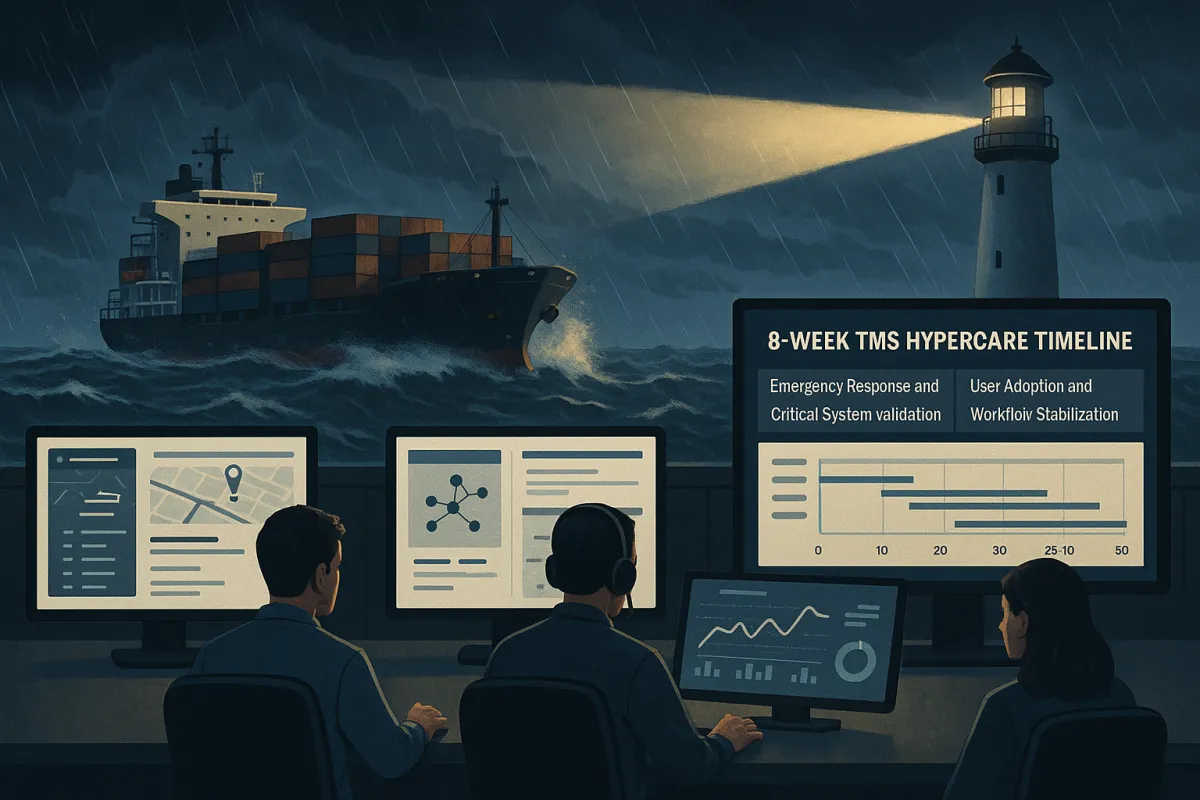
The 8-Week TMS Hypercare Timeline: Phase-by-Phase Breakdown
During hypercare, you have dedicated teams focused exclusively on your implementation, often with on-site presence and immediate availability. Response times are measured in minutes to hours for critical issues. The goal is stabilisation—getting the system running smoothly and users working confidently with new processes.
The timeline structures around four distinct phases, each addressing specific stabilization requirements and user adoption challenges.
Week 1-2: Emergency Response and Critical System Validation
Day one begins with your hypercare command center activated. Agree on a set period of hands-on, rapid-response vendor support after launch with dedicated personnel who know the system and your business. Establish a clear process for logging, tracking and resolving issues quickly.
Daily stand-ups at 8 AM and 4 PM become non-negotiable. Your stabilization lead reviews overnight incidents, validates carrier connectivity status, and confirms data synchronization with your ERP. Critical failure escalation requires vendor response within 2 hours for severity-1 issues affecting shipment creation or carrier communication.
Data quality validation runs continuously. Invoice accuracy rates, shipment status updates, and carrier response times get monitored every 4 hours. A successful TMS implementation reduces freight invoice errors by 30–50% within six months; if error rates haven't moved, you're experiencing silent failure.
Carrier integration monitoring identifies the most common week-1 failures: API timeouts, credential authentication errors, and label format mismatches. Your hypercare team maintains direct contact with top 5 carriers to resolve connectivity issues before they impact operations.
Week 3-4: User Adoption and Workflow Stabilization
User adoption tracking becomes the primary focus. Organizations that omit a formal change management program routinely see adoption rates collapse within the first 90 days of go-live, erasing the anticipated operational gains. Implementations that omit these elements often see usage rates decline within 90 days of go-live, at which point recovery requires effort that rivals the original implementation cost.
The 70% adoption threshold drives daily measurement. You track login frequency, feature utilization, and task completion rates across user roles. Planners should complete 80% of shipment bookings through the TMS, while dispatchers need 90% visibility query success rates.
Shadow system elimination requires active intervention. When users maintain parallel spreadsheets or email workflows, you document the specific gaps driving workaround behavior. Most shadow systems emerge from missing functionality that wasn't identified during testing under real operational volumes.
Training gap remediation addresses the most common adoption barriers. Users struggling with new workflows need targeted sessions, not generic system overview training. Your hypercare team provides role-specific guidance focused on daily task completion.
The TMS Hypercare Command Center: Roles, Responsibilities, and Governance
Successful hypercare requires dedicated resources distinct from your implementation project team. Hypercare support typically involves a dedicated team, normally formed from both the project team that configured and deployed the solution and the business experts that will champion the system into the future, who are readily available to assist users with any difficulties they encounter during the initial phase post-implementation.
The stabilization lead owns the program and determines exit criteria. This role differs from your implementation project manager—you need someone focused exclusively on operational stability, not project delivery milestones. They coordinate between internal teams and vendor support, manage escalation procedures, and decide when to transition out of hypercare.
Cross-functional team structure includes operations leads from each affected department, IT liaison for technical issues, and dedicated vendor support contacts. Implementation Lead (sometimes Hypercare Manager): owns the program, sets exit criteria, calls the exit. Support Lead: owns day-to-day case flow, escalations, SLA recovery. CSM: owns account-level health signals, churn risk, customer-side communication.
Different vendors structure hypercare differently. Manhattan Active typically provides dedicated customer success managers during stabilization, while Transporeon offers technical specialists focused on integration issues. E2open (now part of WiseTech Global) emphasizes process optimization during hypercare, and Cargoson provides hands-on workflow validation with operational experts.
Decision authority must be clearly defined. Your stabilization lead needs authority to make configuration changes, approve emergency fixes, and escalate issues directly to vendor management without IT approval workflows that slow response times during critical incidents.
Critical Metrics and Success Criteria for TMS Stabilization
Transition out of hypercare requires measurable criteria, not subjective assessments of system stability. Transaction accuracy thresholds provide the foundation: 95% shipment creation success rate, 90% carrier response accuracy, and invoice matching rates above 85%.
System performance benchmarks include response times under 3 seconds for shipment queries, 99.5% uptime excluding scheduled maintenance, and integration synchronization within 15 minutes for critical data updates.
User adoption rates need sustained measurement. 70% of eligible users must actively utilize the system, with feature utilization above 60% for core functionality like shipment tracking, carrier communication, and performance reporting.
Support ticket volume normalization indicates stabilization success. Daily incidents should decrease by 50% between week 2 and week 6, with severity-1 tickets occurring less than twice weekly by hypercare exit.
Different platforms require adjusted metrics. Cloud-based systems like nShift and FreightPOP typically achieve faster performance stabilization but may need longer user adoption periods. Legacy platforms such as SAP TM require extended integration validation but often show higher user retention once stabilized. Cargoson implementations usually demonstrate consistent metrics across both technical performance and user adoption due to their focus on operational workflow design.
Common TMS Hypercare Failure Patterns and Prevention Strategies
Integration failures represent the most predictable hypercare disasters. Poor data governance and untested integrations between TMS platforms, ERP systems, and carrier networks are among the most consistent drivers of failed implementations. Data synchronization issues emerge when real transaction volumes exceed testing scenarios, causing delays in shipment status updates and inventory availability.
User resistance and adoption collapse follow recognizable patterns. Organizations that configure the system around existing processes, rather than using implementation to drive process improvement, typically reproduce the inconsistencies that made the legacy environment difficult to manage in the first place. Users revert to familiar tools when the TMS doesn't improve their daily workflows.
Performance degradation under real-world volumes catches most implementations unprepared. Testing with sample data doesn't reveal bottlenecks that emerge with full carrier networks, complex routing requirements, and peak season transaction volumes.
Prevention requires proactive monitoring of these known failure modes. Your hypercare protocol must include automated alerts for integration delays, daily measurement of user adoption metrics, and performance testing under realistic load conditions.
Vendor-specific prevention strategies vary significantly. Descartes implementations need careful carrier connectivity validation due to their extensive network integrations. MercuryGate requires workflow optimization focus during hypercare. Cargoson benefits from their operational workflow validation approach that identifies adoption barriers before they become entrenched habits.
The 48-Hour Emergency Response Playbook
Critical hypercare incidents require immediate response protocols that bypass normal IT support channels. Establish a clear process for logging, tracking and resolving issues quickly. Ensure your team knows exactly how to reach your vendor, what support channels are available and the escalation procedures for urgent cases.
Incident classification determines response urgency. Severity-1 includes system unavailable, shipment creation failures, or carrier communication outages affecting operations. Severity-2 covers performance degradation, data synchronization delays, or feature malfunctions that allow workarounds. Severity-3 addresses usability issues and enhancement requests.
Emergency escalation contacts must be available 24/7 during hypercare. Your vendor should provide direct mobile numbers for technical leads, not generic support ticket systems. Escalation occurs automatically if initial response doesn't happen within agreed timeframes.
System rollback protocols become necessary when emergency fixes create additional problems. Your hypercare team needs authority to revert configurations, disable integrations, or activate backup processes without extended approval chains.
Communication templates for stakeholders prevent confusion during critical incidents. Pre-written messages for carriers, customers, and internal users explain service impacts and expected resolution times. Quick communication maintains confidence during the most challenging hypercare situations.
Week 5-8: Performance Optimization and Handover Preparation
Performance optimization begins once basic stability is achieved. Finance transformations often introduce new workflows, reporting structures, and data models. The hypercare phase provides a controlled environment where finance teams validate that these changes function correctly in live operations. The same principle applies to transportation operations.
Exception handling refinement addresses the operational edge cases that only emerge after weeks of real-world usage. Most TMS implementations handle standard shipments well, but struggle with expedited freight, multiple-stop deliveries, or complex billing requirements that weren't fully tested during implementation.
Success metrics validation ensures you're measuring outcomes that actually matter. A TMS implementation should produce measurable improvement in at least two of the following within 12 months: carrier on-time delivery rates, freight cost per lane or operational efficiency gains.
Handover preparation structures the transition from hypercare to steady-state operations. Documentation requirements include configuration settings, workflow procedures, escalation contacts, and ongoing optimization opportunities. Knowledge transfer sessions ensure your internal team can maintain system performance without intensive vendor support.
Different TMS platforms require varying optimization approaches. E2open focuses on network optimization and carrier performance analytics. Manhattan Active emphasizes warehouse integration and inventory synchronization. Cargoson provides operational workflow refinement that improves daily user efficiency.
Post-Hypercare: Transitioning to Steady-State Operations
Structured handover from hypercare to normal operations prevents the gradual degradation that affects many TMS implementations months after go-live. Hypercare does not replace continuous support: Once the Hypercare period is over, regular support mechanisms should be in place. Hypercare is intended to stabilize the system, but businesses must continue delivering consistent support post-Hypercare.
Documentation requirements include complete configuration records, workflow standard operating procedures, vendor contact information, and escalation procedures. Your internal team needs sufficient information to maintain operations without depending on hypercare-level vendor support.
Ongoing optimization identification captures improvement opportunities discovered during hypercare but not implemented due to stability priorities. These become your enhancement roadmap for the following quarters.
Long-term success monitoring establishes the metrics and review cycles that prevent gradual adoption decay. Monthly user adoption reviews, quarterly performance assessments, and annual optimization planning maintain the gains achieved during hypercare.
Platform-specific considerations shape your steady-state approach. Manhattan Active provides ongoing optimization tools that your team can use independently. E2open offers analytics capabilities that require regular utilization to maintain value. Cargoson emphasizes operational efficiency metrics that help teams identify continuous improvement opportunities.
Your hypercare investment pays dividends when structured properly. Organizations that implement formal hypercare protocols avoid joining the 75% of European TMS implementations experiencing budget overruns and operational disappointment. The eight-week framework provides the structure needed to transform TMS go-live from crisis management into operational success.